
About the lecture
YouTube video will load only after you consent to external media.
Since the 2008 financial crisis and the Arab revolutions of 2010–2011, societal collapse and transformation have attracted increasing attention. Climate problems, the COVID-19 pandemic and the threat of nuclear conflict have intensified this interest. Archaeology and history have become particularly relevant sciences for the twenty-first century because of their extensive experience of the decline and fall of past civilisations and societies.
We will ask why the Western Roman Empire collapsed and how stone statues contributed to the end of settlement on Easter Island. We will discuss the disappearance of Viking settlements in Greenland, how the Little Ice Age and plague nearly destroyed medieval society, the decline of the ancient Maya and problems in Bronze Age Egypt.
Collapse never has a single cause. The lecture considers ancient and medieval epidemics, climate change, historical economies, wars and migration. Collapse has accompanied us since the first cities and states. Every case is different, yet many share features that can also be observed today.
We will seek answers to the questions: What and who collapses? Why did collapse occur? Have societies survived their own collapse?
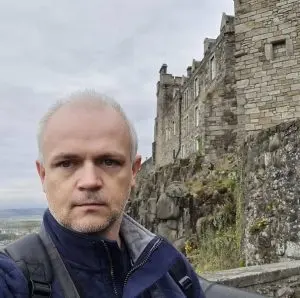 Mgr. Branislav Kovár, PhD., studied Archaeology and History at the Faculty of Arts, Comenius University in Bratislava. He has joined expeditions in France, Kuwait, Guatemala and Sudan and works at the Institute of Archaeology of the Slovak Academy of Sciences in Nitra. He contributes to HistoryLab.sk and co-authored Kolaps očami archeológie, Archaeology of Failaka and Kuwaiti Coast, História pre zaneprázdnených and Epidémie v dejinách. He wrote Sila zániku. Kolapsy starovekých a stredovekých spoločností. At the time of the lecture, his new book Klíma v dejinách. Ako ľudí ovplyvňovala príroda a klimatické zmeny was being published.
The lecture took place online; the recording is available on YouTube:
Lecture date and time: 27. 4. 2023 at 17:30 – 19:00
The lecture series was supported using public funds by the Slovak Arts Council.