About the lecture
YouTube video will load only after you consent to external media.
Ethnographers recorded the custom of carrying out Morena in the late nineteenth and first half of the twentieth century. Analogous rituals, apparently of pre-Christian origin, occur in other Slavic countries. But who was the effigy called Morena? Romantic-era scholars and figures of the Slovak National Revival regarded her as a Slavic goddess of winter; later scholarship treated her as a personification of that season. Comparative linguistics, mythology and folklore can help us understand the ritual's structure and explore the origins of names such as Morena, Mamuriena, Marmoriena and Majmoriena.
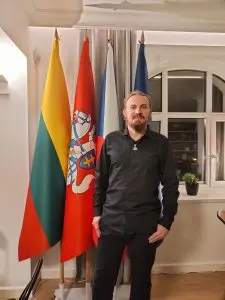 Mgr. Stanislav Gubančok is a full-time doctoral researcher at the Department of Ethnology and Non-European Studies, Faculty of Arts, University of Ss. Cyril and Methodius in Trnava, studying comparative Baltic and Slavic mythology. Among the first Slovak specialists to take an interest in Baltic languages and culture, he is undertaking a placement at Vytautas Magnus University in Kaunas, Lithuania. Drawing on his dissertation comparing Lithuanian and Slovak spring customs, he presents the Slovak carrying-out-of-Morena ritual alongside its Lithuanian analogue.
The lecture took place online and can be watched on YouTube:
Lecture date and time: 17. 5. 2023 at 17:30 – 19:00
The lecture series was supported using public funds by the Slovak Arts Council.