
About the lecture
The prehistoric inhabitants of north-eastern Africa, and later particularly those of the Nile Valley, were profoundly influenced by their environment and natural forces. These included the sun, with which they developed a relationship in prehistoric times. Its importance peaked during the Old Kingdom, approximately 2590–2120 BCE, when monumental complexes clearly reflected the solar cult's influence on royal architecture. The scarcity of contemporary religious texts about the cult's early development, together with extensive damage to tomb decoration and other inscriptions, makes it difficult, if not impossible, to define that influence precisely. The most coherent source is the Pyramid Texts, religious texts carved inside royal pyramids from the end of the Fifth Dynasty. They are associated with the growing importance of Osiris, the divine ruler of the underworld, as the solar cult lost its dominant position in elite funerary beliefs. Nevertheless, the solar cult remained central to the ancient Egyptian worldview and continued to develop during the Middle Kingdom, approximately 1980–1760 BCE. Pyramid complexes built during this ‘classical’ period also reflected its development, albeit in altered forms. The New Kingdom, approximately 1539–1077 BCE, saw another peak as Egypt's imperial power reached its height, particularly through the solar cult's fusion with other cults, above all that of Amun. This process is documented in the architecture of major temple complexes and in religious texts.
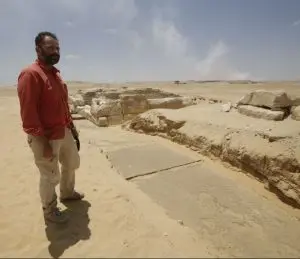
Doc. Mgr. Jaromír Krejčí, PhD., has worked at the Czech Institute of Egyptology, Faculty of Arts, Charles University, since 1993. His long-standing research concerns Egyptian archaeology and history in the third and second millennia BCE and the development of Egyptian architecture. He has participated in excavations in Egypt since 1991 and coordinated research at the royal pyramid necropolis at Abusir since 1994. In 2017–2019 he was a co-investigator on the Czech Science Foundation project on the origins and development of the solar cult and architecture in third-millennium BCE Egypt. Since the late 1990s, he has taught at the institute, supervised and reviewed theses, co-organised international conferences and workshops, including Abusir and Saqqara and Solar Cult and Royal Ideology in Ancient Egypt, and promoted Egyptology through public lectures, exhibitions and media appearances.
Lecture venue:
Historical premises of the East Slovak Museum in Košice, Námestie Maratónu mieru 2, Košice
https://goo.gl/maps/yiai3FnbbXrxowNk7
Lecture date and time: 2. 12. 2020 at 17:30 – 19:00
The lecture series was supported using public funds by the Slovak Arts Council.