All projects
CEREHIS / Research and public-engagement projects

Project

2024 – 2026

Deliberative Democracy

Lectures and activities supporting democratic participation.

Deliberative Democracy — project photograph

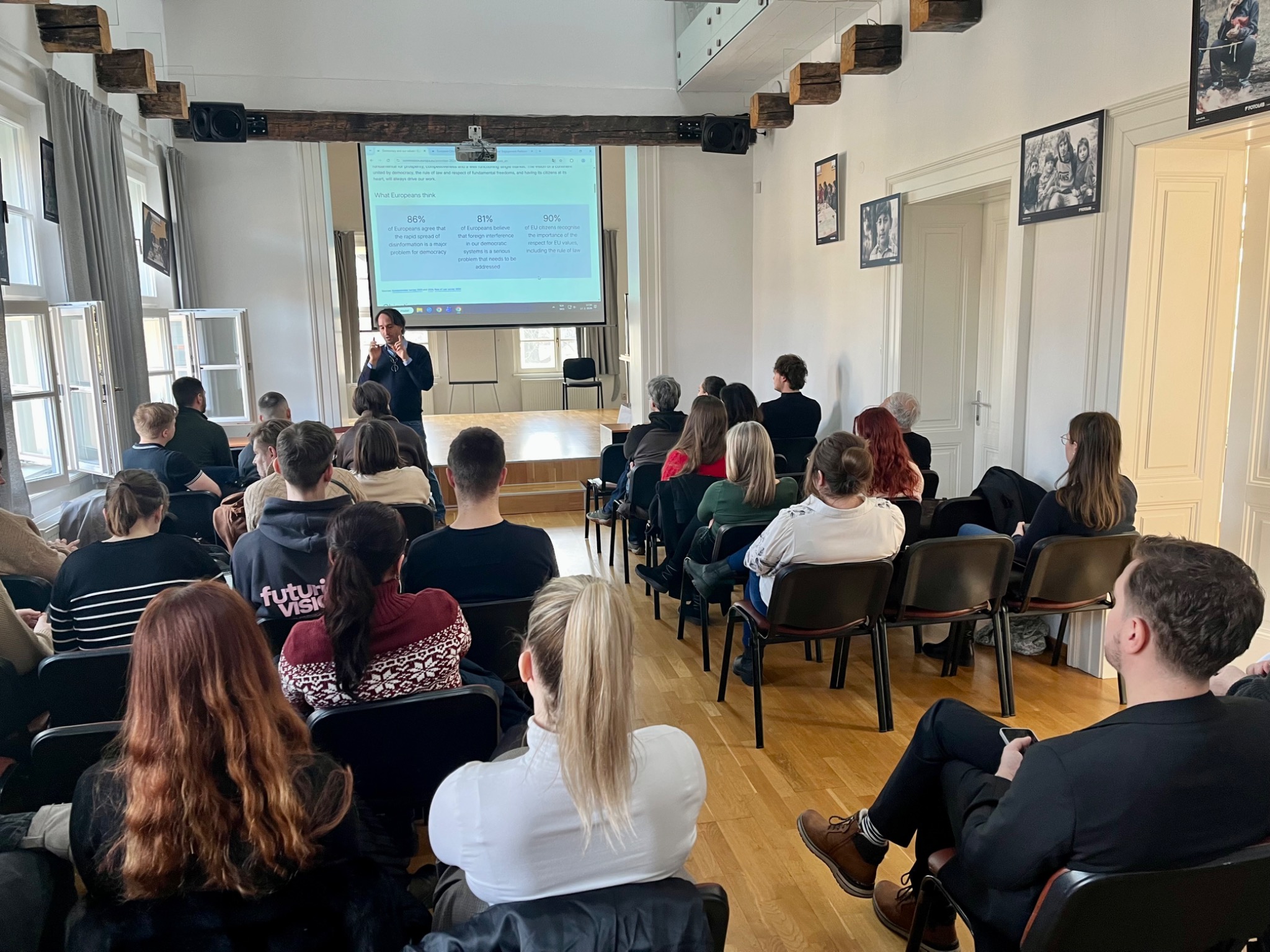
In February 2026, we hosted Italian philosopher Michele Fiorillo, who brought the topic of democracy to Slovak universities. During his visit, we organised events for students and the general public at Pavol Jozef Šafárik University in Košice and Comenius University in Bratislava.

About the speaker:

Michele Fiorillois a political philosopher.

Having studied at the Scuola Normale Superiore and the College of Europe, he focuses on the history of ideas, theories of democracy and European integration.

He collaborates with INDIRE, the Foundation for European Progressive Studies, and the Center for United Nations Constitutional Research. In addition, he is a co-initiator of CIVICO Europa and Citizens Take Over Europe—a European coalition of more than 70 NGOs—where he also co-leads the European Citizens’ Assembly project. He has edited the cultural and political magazines ilcontesto and Il pensiero democratico, and contributes to MicroMega, Social Europe, and The Federalist Debate.

Recently he was the editor of Ten Elections. A history of the European Parliament at the ballot box (2024) published by EUROM – the European Observatory on Memories of the University of Barcelona – jointly with the Jean Monnet House/European Parliament.

Visit programme

Lectures and abstracts

Open a lecture title to read its abstract.

Košice17 and 18 February 2026

Bratislava24 and 26 February 2026

17. 2. 2026Renewable Democracy

Seminar for Political Science students, Pavol Jozef Šafárik University in Košice

Building the European demos, between supranational representation and deliberative participation. The seminar included a workshop with students in the form of a model European Citizens’ Assembly on the topic: ‘How to strengthen European democracy?’

Open the lecture page
17. 2. 2026The Crisis of European Democracy and the Power of People’s Deliberation

Public lecture, Pavol Jozef Šafárik University in Košice

European democracy is in crisis: since long time now, citizens across the continent have been distrustful of national and European institutions, as well as political elites. This is also a result of the EU’s democratic deficit: the European Parliament, elected by the European people, has no real power of legislative initiative, and conflicting reasons of state influence the Council. As a result, the EU is unable to act as it could with more democratic supranational governance that takes into account the European people as a whole. We have a common market, but no common social policy for the whole continent, and this is undermining the legitimacy of the EU, favouring national-populist forces in all Member States, which are calling for the return of national sovereignty. But no Member State will be able to save itself from the increasingly dangerous global disorder unless it acts together with others in cooperation to move towards a stronger democratic Union, capable of realising its strategic autonomy and keep alive the prospect of a peaceful world governed by the rule of law, instead of violence.

Without continuous popular pressure on the Council and other EU institutions, Europe will not take further decisive steps in the necessary direction.

There is therefore an urgent need to rethink the role of European people: especially in times of great uncertainty, citizens’ involvement in decision-making becomes crucial to strengthening our democracies, through innovative instruments of participatory, direct and deliberative democracy, beyond the nation state. What would happen if ordinary people from across Europe were brought together to deliberate on the common good, beyond party divisions and national borders? The European Citizens’ Panels – launched during the Conference on the Future of Europe – which bring together citizens selected at random from across the continent and from all walks of life, are a little positive step in this direction, paving the way for the potential establishment of a permanent European Citizens’ Assembly as a complementary pillar to EU representative democracy. This process could finally lead to the emergence of a transnational civic constituent power capable of shaping a truly European demos – or even a European nation – with its own democratic supranational constitution.

Open the lecture page
18. 2. 2026The Force of Will (and That of Things): On the Idea of Historical Progress in Gramsci’s Philosophy of Praxis

Lecture for Philosophy students, Pavol Jozef Šafárik University in Košice

Is humanity constantly progressing towards the better? Such a question may seem meaningless or unthinkable to our contemporaries, especially after the tragedies of the last century and in light of the growing global existential crises of the present.

Immanuel Kant answered affirmatively in his time, drawing on the experience of the French Revolution as a sign of humanity’s moral tendency towards improvement, with the possible prospect of perpetual peace through a constitutional world federation. Another revolution was an opportunity for Antonio Gramsci to reflect on the link between will and historical evolution, beyond any determinism borrowed from the natural sciences.

How much influence do socio-economic structures have and how much do ideas have? How are the prediction of events and practice connected? How much can humanity influence its own destiny?

Open the lecture page
24. 2. 2026The Democratic Daimon

Lecture for students, Department of Comparative Religion, Comenius University in Bratislava

The lecture presents the concept of the Democratic Daimon through Socratic philosophy, with particular attention to the role of dialogue as a fundamental practice of democratic life. Socrates’ daimonion is described in Plato’s corpus as an internal, irrational voice that intervenes negatively—it delays action rather than prescribing doctrine. Socrates’ daimon is understood here as a philosophical and civic tool mediating the relationship between individual conscience and the collective space of the polis. By placing Socrates in the democratic context of classical Athens, the lecture examines how the daimon voice operates in tension with democratic norms of persuasion, majority rule, and public deliberation. From a comparative perspective, the lecture argues that Socrates’ daimon foreshadows later religious and philosophical conceptions of conscience, but cannot be reduced to a purely internal or individualistic understanding. Returning to Socrates allows us to rethink democracy as a way of life that requires not only consensus but also restraint, ethical vigilance, and openness to being challenged.

Open the lecture page
26. 2. 2026European Deliberative Democracy

Lecture for Political Science students, Comenius University in Bratislava

The current crisis of European democracy has exposed structural tensions between representative institutions and citizens’ expectations of meaningful political participation, particularly within the multi-level and supranational governance architecture of the European Union. Declining public trust, the rise of national populism, and the spread of political disinformation have intensified concerns about democratic legitimacy and responsiveness, prompting renewed interest in alternative and complementary democratic models.

This lecture examines deliberative democracy as both a normative framework and an emerging institutional practice capable of addressing these challenges by re-centring political decision-making on inclusive, reasoned, and informed public dialogue. Deliberative democracy is understood not as a substitute for representative government, but as a participatory pillar designed to enhance its legitimacy by enabling citizens to engage collectively in the formation of political judgement.

Particular attention is devoted to the Conference on the Future of Europe, which marked a significant innovation in EU democratic practice through the introduction of European Citizens’ Panels. These transnational deliberative bodies, composed of randomly selected citizens from all Member States and diverse social backgrounds, were tasked with formulating policy recommendations in dialogue with experts and institutional actors. The lecture analyses the design, functioning, and outcomes of these panels as a concrete expression of European deliberative democracy at the supranational level, situating them within a broader ecosystem of deliberative practices developed at national, regional, and local levels across Europe.

While such mechanisms have demonstrated potential in fostering civic learning, cross-national solidarity, and epistemic quality in policymaking, they also raise important trade-offs concerning political uptake, institutional integration, and democratic accountability. Building on these experiences, the lecture explores the normative and political implications of moving towards a permanent European Citizens’ Assembly as a fully fledged participatory institution of the Union, capable of complementing representative democracy and contributing to future processes of institutional and constitutional reform within the European project. The lesson concluded with a workshop with students in the form of a model European Citizens’ Assembly on the topic: ‘How to strengthen European democracy?’

Open the lecture page
CEREHIS

Centre for European History and Intercultural Dialogue · Košice